Buy lopezrubiolab.eu ?
We are moving the project
lopezrubiolab.eu .
Are you interested in purchasing the domain
lopezrubiolab.eu ?
domain@kv-gmbh.de · 0541-91531010
Buy lopezrubiolab.eu ?
Is the square axis-symmetric, but not point-symmetric?
Yes, a square is axis-symmetric, meaning it has rotational symmetry around its center axis. However, it is not point-symmetric, as it does not have reflectional symmetry across any point within the shape. This is because a square does not have a point that can be reflected across to create a matching image. **
Which capital and lowercase letters are rotationally symmetric and reflection symmetric?
The capital letters that are both rotationally symmetric and reflection symmetric are "I", "O", "S", "H", "X", and "Z". The lowercase letters that are both rotationally symmetric and reflection symmetric are "o" and "x". These letters look the same when rotated 180 degrees or when reflected across a vertical line. **


Similar search terms for Symmetric
Top-Angebote
Products related to Symmetric:
-
CGP Books GCSE Combined Science: Biology AQA Revision Question Cards: superb for the 2024 and 2025 exams (CGP AQA GCSE Combined Science)It’s all very well reading through your study notes, but how much can you actually remember? Put your GCSE Biology knowledge to the test with CGP’s brilliant Revision Question Cards! There are 63 cards in the pack, covering all the key Biology topics from the Grade 9-1 AQA (Trilogy Specification) Combined Science course. Each one starts off with quick questions to warm you up, followed by harder questions to get your brain into top gear. Flip the card over and you’ll find full answers to each question, carefully written to help you understand everything you need to know. Along the way, we’ve packed in plenty of diagrams and expert revision tips, and there are even questions on Working Scientifically and Practical Skills. Amazing!6,95 £*Shipping: 2,99 £Secure redirect to the provider
-
CGP Books GCSE AQA Combined Science Revision Question Cards 3 Pack Set (Chemistry, Physics, Biology)To cut to the chase, there’s more to revision than just reading through study notes. If you really want to make sure you know GCSE Chemistry, Physics and Biology you’ll need to test yourself - and that’s where these CGP Revision Question Cards come in! There are 95 cards in the pack, covering every key Grade 9-1 AQA topic. Each one starts off with quick questions to warm you up, followed by harder questions to get your brain into top gear. Flip the card over and you’ll find full answers to each question, carefully written to help you understand everything you need to know. Along the way, we’ve packed in plenty of diagrams and expert revision tips, and there are even questions on Working Scientifically and Practical Skills. Amazing!21,99 £*Shipping: 2,99 £Secure redirect to the provider
-
Uplift Picks Magic Crystal Growing Christmas Tree Science Experiment Toy For Kids white Snowman 15 CmTurn curiosity into wonder with a fun activity that feels like magic. This hands on science toy lets children watch crystals grow and bloom on a paper tree, creating a colorful and exciting transformation. Easy to set up and fascinating to observe,...54,98 $*Shipping: 0,00 $Secure redirect to the provider
-
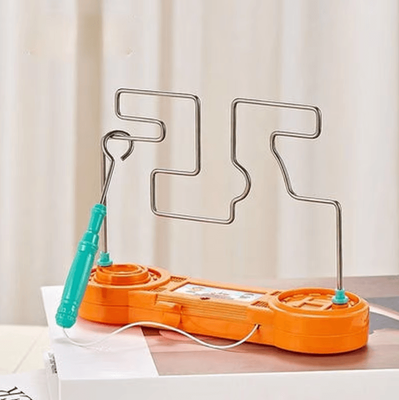
Uplifted Finds Kids Collision Electric Shock Toy Education Electric Touch Maze Game Party Funny Science Experiment Toy orangeBring excitement and learning together with this electric touch maze game for kids. Designed to develop hand eye coordination, focus, and problem solving, this fun science toy challenges children to guide the wand through the maze without touching...42,97 $*Shipping: 0,00 $Secure redirect to the provider


-
Can a rational function be both axis-symmetric and point-symmetric?
No, a rational function cannot be both axis-symmetric and point-symmetric. If a rational function is axis-symmetric, it means that it is symmetric with respect to the y-axis, while point-symmetry would require symmetry with respect to the origin. These two types of symmetry are mutually exclusive, so a rational function cannot exhibit both types of symmetry simultaneously. **
-
Can a polynomial function be both axis-symmetric and point-symmetric?
No, a polynomial function cannot be both axis-symmetric and point-symmetric. If a polynomial function is axis-symmetric, it means that it is symmetric with respect to the y-axis, while if it is point-symmetric, it means that it is symmetric with respect to the origin. These two types of symmetry are mutually exclusive, so a polynomial function cannot exhibit both types of symmetry simultaneously. **
-
Which uppercase and lowercase letters are rotationally symmetric and reflection symmetric?
The uppercase letters that are both rotationally symmetric and reflection symmetric are 'H', 'I', 'N', 'O', 'S', 'X', and 'Z'. The lowercase letters that are both rotationally symmetric and reflection symmetric are 'o' and 'x'. These letters look the same when rotated 180 degrees or when reflected across a vertical axis. **
-
Which capital letters of the alphabet are point symmetric and axis symmetric?
The capital letters of the alphabet that are point symmetric are A, H, I, M, O, T, U, V, W, X, and Y. These letters look the same when rotated 180 degrees around their center point. The capital letters that are axis symmetric are A, H, I, M, O, T, U, V, W, X, and Y. These letters look the same when reflected across a vertical axis. **

Which capital letters of the alphabet are point-symmetric and axis-symmetric?
The capital letters of the alphabet that are both point-symmetric and axis-symmetric are the letter "H" and the letter "I". These letters have vertical symmetry as well as symmetry when rotated 180 degrees. This means that they look the same when flipped vertically or rotated 180 degrees around their center point. **
Does "symmetric to the origin" always mean point symmetric in profile tasks?
No, "symmetric to the origin" does not always mean point symmetric in profile tasks. In profile tasks, "symmetric to the origin" means that the object is symmetric with respect to the origin of the coordinate system, which is the point (0,0). This means that if you reflect the object across the x-axis and the y-axis, it will look the same. Point symmetry, on the other hand, means that the object is symmetric with respect to a specific point, not necessarily the origin. Therefore, while point symmetry implies symmetry to the origin, symmetry to the origin does not always imply point symmetry in profile tasks. **
Top-Angebote
Products related to Symmetric:
-
Uplift Curations Electric Shock Toy For Kids Educational Touch Maze Game & Science Experiment Gift greenTurn playtime into a fun learning adventure with this electric shock toy designed to entertain and educate. Whether at a birthday party or in the classroom, this kids science game offers a handson way for children to explore circuits and steadyhand...62,50 $*Shipping: 0,00 $Secure redirect to the provider
-
CGP Books GCSE Combined Science: Biology AQA Revision Question Cards: superb for the 2024 and 2025 exams (CGP AQA GCSE Combined Science)It’s all very well reading through your study notes, but how much can you actually remember? Put your GCSE Biology knowledge to the test with CGP’s brilliant Revision Question Cards! There are 63 cards in the pack, covering all the key Biology topics from the Grade 9-1 AQA (Trilogy Specification) Combined Science course. Each one starts off with quick questions to warm you up, followed by harder questions to get your brain into top gear. Flip the card over and you’ll find full answers to each question, carefully written to help you understand everything you need to know. Along the way, we’ve packed in plenty of diagrams and expert revision tips, and there are even questions on Working Scientifically and Practical Skills. Amazing!6,95 £*Shipping: 2,99 £Secure redirect to the provider
-
CGP Books GCSE AQA Combined Science Revision Question Cards 3 Pack Set (Chemistry, Physics, Biology)To cut to the chase, there’s more to revision than just reading through study notes. If you really want to make sure you know GCSE Chemistry, Physics and Biology you’ll need to test yourself - and that’s where these CGP Revision Question Cards come in! There are 95 cards in the pack, covering every key Grade 9-1 AQA topic. Each one starts off with quick questions to warm you up, followed by harder questions to get your brain into top gear. Flip the card over and you’ll find full answers to each question, carefully written to help you understand everything you need to know. Along the way, we’ve packed in plenty of diagrams and expert revision tips, and there are even questions on Working Scientifically and Practical Skills. Amazing!21,99 £*Shipping: 2,99 £Secure redirect to the provider
-
Is the square axis-symmetric, but not point-symmetric?
Yes, a square is axis-symmetric, meaning it has rotational symmetry around its center axis. However, it is not point-symmetric, as it does not have reflectional symmetry across any point within the shape. This is because a square does not have a point that can be reflected across to create a matching image. **
-
Which capital and lowercase letters are rotationally symmetric and reflection symmetric?
The capital letters that are both rotationally symmetric and reflection symmetric are "I", "O", "S", "H", "X", and "Z". The lowercase letters that are both rotationally symmetric and reflection symmetric are "o" and "x". These letters look the same when rotated 180 degrees or when reflected across a vertical line. **
-
Can a rational function be both axis-symmetric and point-symmetric?
No, a rational function cannot be both axis-symmetric and point-symmetric. If a rational function is axis-symmetric, it means that it is symmetric with respect to the y-axis, while point-symmetry would require symmetry with respect to the origin. These two types of symmetry are mutually exclusive, so a rational function cannot exhibit both types of symmetry simultaneously. **
-
Can a polynomial function be both axis-symmetric and point-symmetric?
No, a polynomial function cannot be both axis-symmetric and point-symmetric. If a polynomial function is axis-symmetric, it means that it is symmetric with respect to the y-axis, while if it is point-symmetric, it means that it is symmetric with respect to the origin. These two types of symmetry are mutually exclusive, so a polynomial function cannot exhibit both types of symmetry simultaneously. **
Similar search terms for Symmetric
-
Uplift Picks Magic Crystal Growing Christmas Tree Science Experiment Toy For Kids white Snowman 15 CmTurn curiosity into wonder with a fun activity that feels like magic. This hands on science toy lets children watch crystals grow and bloom on a paper tree, creating a colorful and exciting transformation. Easy to set up and fascinating to observe,...54,98 $*Shipping: 0,00 $Secure redirect to the provider
-
Uplifted Finds Kids Collision Electric Shock Toy Education Electric Touch Maze Game Party Funny Science Experiment Toy orangeBring excitement and learning together with this electric touch maze game for kids. Designed to develop hand eye coordination, focus, and problem solving, this fun science toy challenges children to guide the wand through the maze without touching...42,97 $*Shipping: 0,00 $Secure redirect to the provider
-
Research-powered Eye Duo - Skincare Kit Charlotte Tilbury 3315 Charlotte's Research-powered Eye Duo Size:Darlings, unlock the secret to eyes that appear brighter, depuffed, smoother and younger with my Research-Powered Eye Duo! This CharlotteTilbury.com EXCLUSIVE skincare duo includes:94,05 £*Shipping: 0,00 £Secure redirect to the provider
-
Uplift Curations Electric Shock Toy For Kids Educational Touch Maze Game & Science Experiment Gift orangeTurn playtime into a fun learning adventure with this electric shock toy designed to entertain and educate. Whether at a birthday party or in the classroom, this kids science game offers a handson way for children to explore circuits and steadyhand...62,50 $*Shipping: 0,00 $Secure redirect to the provider
-
Which uppercase and lowercase letters are rotationally symmetric and reflection symmetric?
The uppercase letters that are both rotationally symmetric and reflection symmetric are 'H', 'I', 'N', 'O', 'S', 'X', and 'Z'. The lowercase letters that are both rotationally symmetric and reflection symmetric are 'o' and 'x'. These letters look the same when rotated 180 degrees or when reflected across a vertical axis. **
-
Which capital letters of the alphabet are point symmetric and axis symmetric?
The capital letters of the alphabet that are point symmetric are A, H, I, M, O, T, U, V, W, X, and Y. These letters look the same when rotated 180 degrees around their center point. The capital letters that are axis symmetric are A, H, I, M, O, T, U, V, W, X, and Y. These letters look the same when reflected across a vertical axis. **
-
Which capital letters of the alphabet are point-symmetric and axis-symmetric?
The capital letters of the alphabet that are both point-symmetric and axis-symmetric are the letter "H" and the letter "I". These letters have vertical symmetry as well as symmetry when rotated 180 degrees. This means that they look the same when flipped vertically or rotated 180 degrees around their center point. **
-
Does "symmetric to the origin" always mean point symmetric in profile tasks?
No, "symmetric to the origin" does not always mean point symmetric in profile tasks. In profile tasks, "symmetric to the origin" means that the object is symmetric with respect to the origin of the coordinate system, which is the point (0,0). This means that if you reflect the object across the x-axis and the y-axis, it will look the same. Point symmetry, on the other hand, means that the object is symmetric with respect to a specific point, not necessarily the origin. Therefore, while point symmetry implies symmetry to the origin, symmetry to the origin does not always imply point symmetry in profile tasks. **
* All prices are inclusive of VAT and, if applicable, plus shipping costs. The offer information is based on the details provided by the respective shop and is updated through automated processes. Real-time updates do not occur, so deviations can occur in individual cases. ** Note: Parts of this content were created by AI.